

Field notes from the creative pharmacy
Creative midwifery, Double Big Macs, and blinking cursor sweats

Creating something new feels like trying to eat a Double Big Mac as a kid. Where do you even begin? Will your mouth open that wide? It's much easier to nibble on a fry instead, the orange sauce oozing from its patties, taunting you.
It’s been a year and a half since I published Welcome to the Creative Club, and I’m being called to write my first fiction book. I’m clearly experiencing post-labor amnesia, dulling the ache and the awe of that birth.
I forgot how painful beginnings can be. Standing at the bottom of a mountain, staring up at its snow-crusted peak, sun blinding. Instead of lacing up my Salomon boots, I sit on the deck sipping mate lemonade, working on the NYT crossword puzzle. Fuck, it’s hard to start.
My editor shared fifty-nine questions, the first nine developed by Uta Hagen to help actors get into character. She insisted that truthful acting begins with the actor's lived reality, never with performance for its own sake. My English professor at Hunter College once said, “All fiction is nonfiction”.
The questions helped me get into my protagonist’s skin, her needs, wants, pains, history, and blind spots. As the answers intuitively flowed, I felt her arrive. It was such a rush.
Until I got the blinking cursor sweats, again. Where do I go from here?
I tried to pants it, to write the first chapter, and it left me blank and doe-eyed, about to get run over. I was caught between pantsing, writing by the seat of my pants, and plotting like a criminal mastermind.
I was tempted to ghost my idea. Turn around, order another hot chocolate, and take the first train back to a flat city.
I discovered that some plotting is necessary to start the climb. Without those clamps, my inner critic focused on tender young sentences, comparing them to my favorite authors, shaking its red pen in the air.
The resistance was heavy and real.
It was time to renew my creative prescriptions.
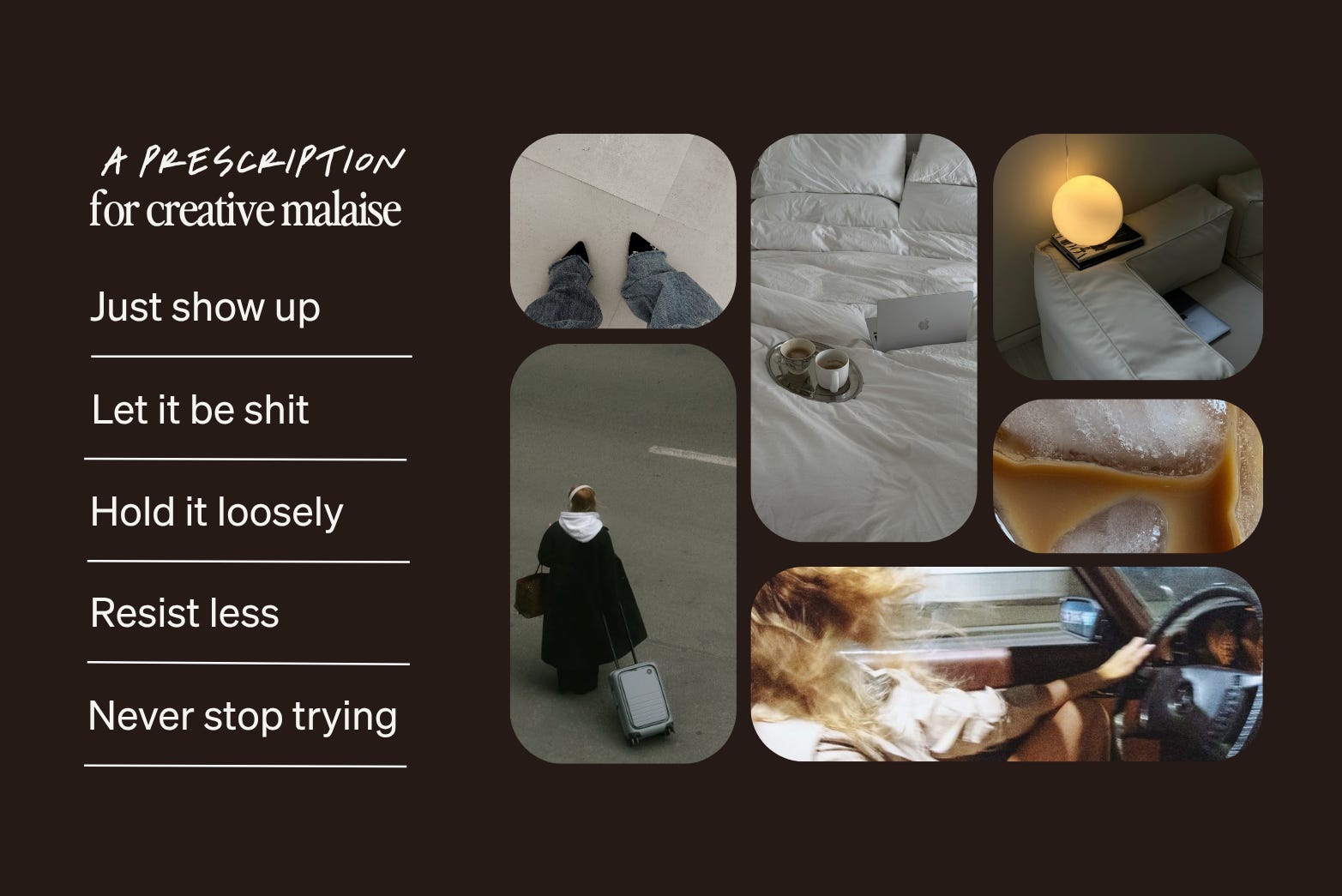
Starting with the most potent one: Just show up.
I booked a two-hour creation date. Whatever happens in that time is what happens, whether one sentence or an exploration of what she wants and what’s pinning her to the ground.
The first date was the hardest. I wanted to do anything but — laundry, bookkeeping, and labelling emails were all suddenly sexy. But I showed up.
I didn’t start writing, but I spent time with my protagonist. I needed a loose idea about where in the story I was dropping into, and to do that, I had to know what came before and what’s coming next.
This gave me direction, even if it was only one step. I’m still terrified, but at least now it’s laced with excitement and possibility. I was able to start — somewhere.
My inner coach got wildly curious about all these feels.
WTF’s going on?
I didn’t know where to start. I resisted writing an outline because I wanted the story to emerge as I wrote it. And I wanted it to be great right out the gate. I’d gotten attached to a specific outcome and timeline. I was applying pressure to the work — the creator and the editor kneading at the same time — and I froze.
So I had to create the vision, but hold it loosely. Not attaching myself to the story going any particular way. The outline was fuel in the tank so I could start driving.
This is true for creating anything, not just a book.
Imagine it in all its glory, what it would smell, taste, look, and feel like (I had flashes of reviews and panel discussions, the scent of ink and paper, grassy matcha on my tongue, the title’s typography on the cover), and then let it go.
I wrote about what stops us from being creative and living creatively in my first book, but somehow forgot to apply its lessons.
I remembered that we don’t create alone.
And, as if on cue, I stumbled across the podcast, How I Write. David Perell’s interviews with Suleika Jaouad and Anne Lamott were like honey, soothing my throat, preparing my voice. These two interviews served tender morsels of insight, messages tailored for the exact time and space I’m in.
Suleika gave me the method. She described how she approached writing her NYT best-selling memoir, Between Two Kingdoms. A visual writer, she started writing the scenes first. Then, she wrote the connective tissue between scenes. This turned the mountain into a hill. I didn't need the beginning — I needed a scene, any scene, and suddenly, there were a dozen ways up.
Anne gave me permission. One of the first things she tells people in her workshop is, “You have got to stop not writing”. Start writing, even if it’s shit. Start writing, even if you don’t know the destination.
She quotes E.L. Doctorow, “Writing is like driving at night in the fog. You can only see as far as your headlights, but you can make the whole trip that way.”
I hold my breath when I hear her say, “The key isn’t to try harder, but to resist less”.
Jesus, talk about synchronicity.
I start again every day, not sure of what I’m doing, but doing it anyway.
The operative word is try.
What if the whole point is to try? That’s it. Not to achieve, to make it, to win, but to try to create it? That thing that makes our bottom lip quiver, palms sweat, and hair stand on end? I don’t know about you, but a life spent trying to create what’s whispering to you at night sounds like a life well lived.
We get to try to make that big, meaty, double-patty creation real. Stretching the corners of our mouths, taking the first bite, the pickle escaping into the diluted ketchup pool.
All we have to do is start.
Keep creating,

As always, slay, queen!